Director's commentary — engineering insights, product updates, and video transcoding deep dives.
Transcodely runs a hosted MCP server at mcp.transcodely.com/mcp. Point Claude at it, authorize in the browser, and it can submit transcoding jobs, ingest and host videos, generate captions, and read back status, playback links, and spend — no key to paste, no gateway to run, and nothing on the surface that deletes.
Two things shipped for people who arrive with an ffmpeg command and a video URL: a converter that turns the command into a Transcodely job request in your browser and names every flag it cannot carry, and a quickstart where one request with managed: true returns a hosted, playable HLS ladder. No bucket, no origin, nothing to configure first.
Per-title encoding went live at 01:05 UTC, was withdrawn at 03:55 after the first real-worker run measured the search producing a larger file, was fixed in the worker, proven on real machines, and re-enabled at 09:25. The root cause was two timebases disagreeing every third frame. Here is the whole day, the arithmetic, and the three reasons CI could not have caught it.
An encoder exits zero on plenty of files that are not what was asked for. Every finished output now carries a report of what the file was measured to be and a verdict on whether it matches the request; the worker refuses to deliver a file that does not; dead input URLs are refused before a machine boots; and there is a free HLS checker that reads your initialization segments, not just your playlist.
An ingest rule is a standing instruction on one of your storage origins: when an object matching these filters lands, create this job. S3, Google Cloud Storage, Supabase Storage and Cloudflare R2 post their own notifications to the rule's endpoint, and no server of yours sits in the path. Here is what it does about duplicates, secrets, paused rules and re-uploads.
Set content_aware.mode to per_title on an output and Transcodely finds the CRF that source needs to reach your VMAF target, then encodes the ladder you declared at it. 1.5x on the output, charged only when a search actually ran. Here is how the search works, what it refuses, and the numbers from the run that qualified it.
Every Mux-alternatives list we could find either quotes no prices or quotes wrong ones. This one reads each vendor's pricing page on a stated date, converts per-minute, per-GB and credit billing onto one worked month, and tells you which alternative fits which reason for leaving.
Elastic Transcoder was discontinued on 13 November 2025, its English documentation is 404, and AWS's converter script calls an API that no longer answers. This guide maps every Elastic Transcoder concept — pipelines, presets, playlists, thumbnails, watermarks, captions, SNS notifications, encryption — to MediaConvert and to Transcodely, with the limits and system-preset IDs AWS's docs used to hold.
Mux bills delivery per minute, Bunny bills per gigabyte, and no comparison converts between them. We do the bitrate math, re-verify every rate on the vendors' own pages, and say where each one wins — including where both beat us.
Our conformance suite runs real transcoding jobs on real worker VMs, probes the produced media with ffprobe, parses the manifests, and recomputes the invoice — for every capability in the API. All 168 cases and all three known gaps are public.
Our first captions implementation spun up a second server for every captioned upload. Here's why that was wrong, how we folded transcription into the encode job itself, and the billing guards we added so an empty caption file can never charge you money.
A walkthrough for wiring Transcodely's MCP server into Claude Code: one registration command, a browser authorize, and four workflows the shipped tools actually support — host, transcode, caption, audit spend — plus the limits worth knowing before you hand an agent a billable API.
Every video can now ship with accurate, automatically generated captions — one flag on hosted uploads, one line on API jobs, €0.05 per source minute. Transcribed on our own workers, delivered inside your HLS/DASH manifest, and never billed for silence.
Cloudflare R2 is now a first-class storage origin in Transcodely. Point a transcoding job at an R2 bucket with just your account ID — then deliver the output to viewers with zero egress fees.
Upload a video, get back an HLS stream, an embeddable player, and a CDN URL. Transcodely now ships an end-to-end hosting layer on top of our transcoding API — priced per GB, not per seat.
A practical comparison of the four major video codecs — compression efficiency, encoding speed, device support, licensing costs, and when to use each.
After a decade of fighting overpriced transcoding services, misleading pricing, and manual VMAF calculations, I built the encoding API I always wanted.
An honest comparison of video encoding costs across AWS MediaConvert, Mux, Coconut, Bitmovin, Google Cloud, and Transcodely — with real numbers.
VMAF is the perceptual quality metric Netflix uses to measure video quality. Here's how it works, what scores mean, and why your encoding pipeline needs it.
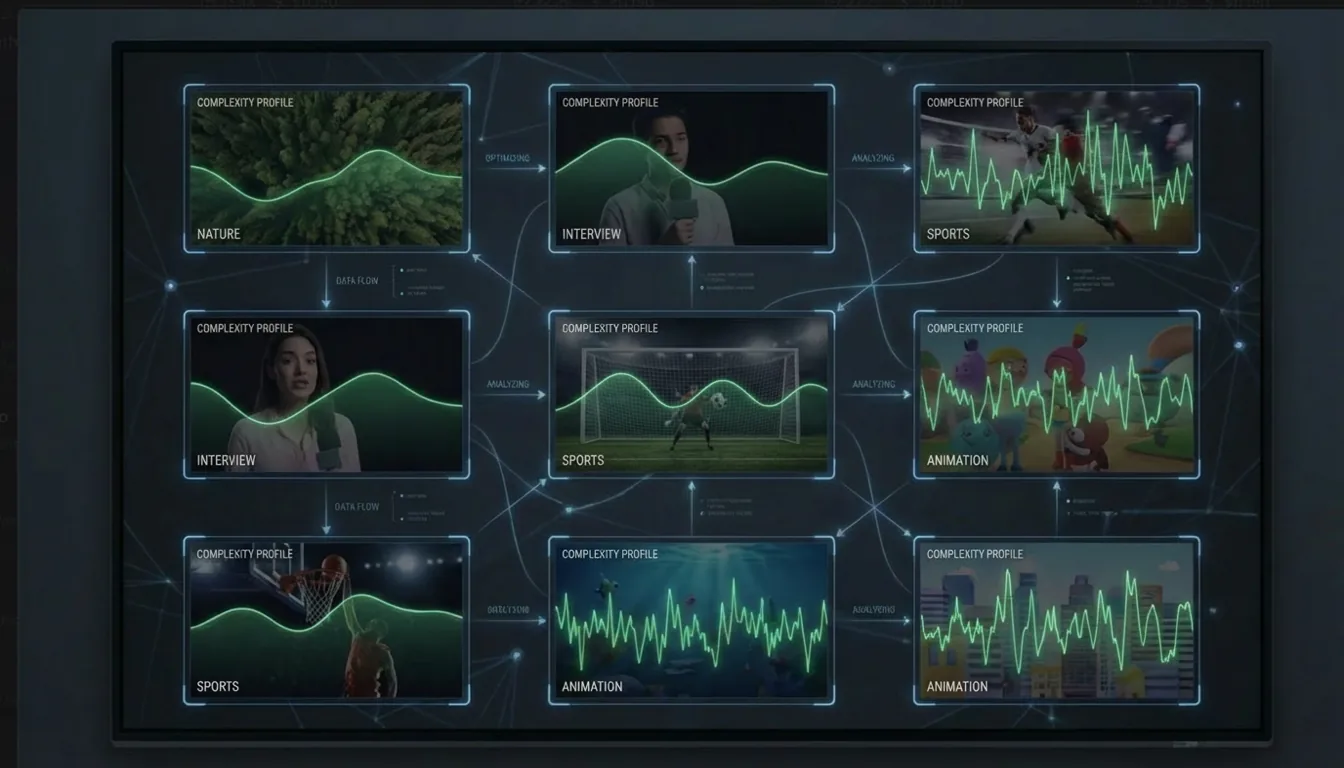
Per-title encoding analyzes each video's complexity to generate optimal bitrate ladders — saving 20-50% on bandwidth without sacrificing quality.
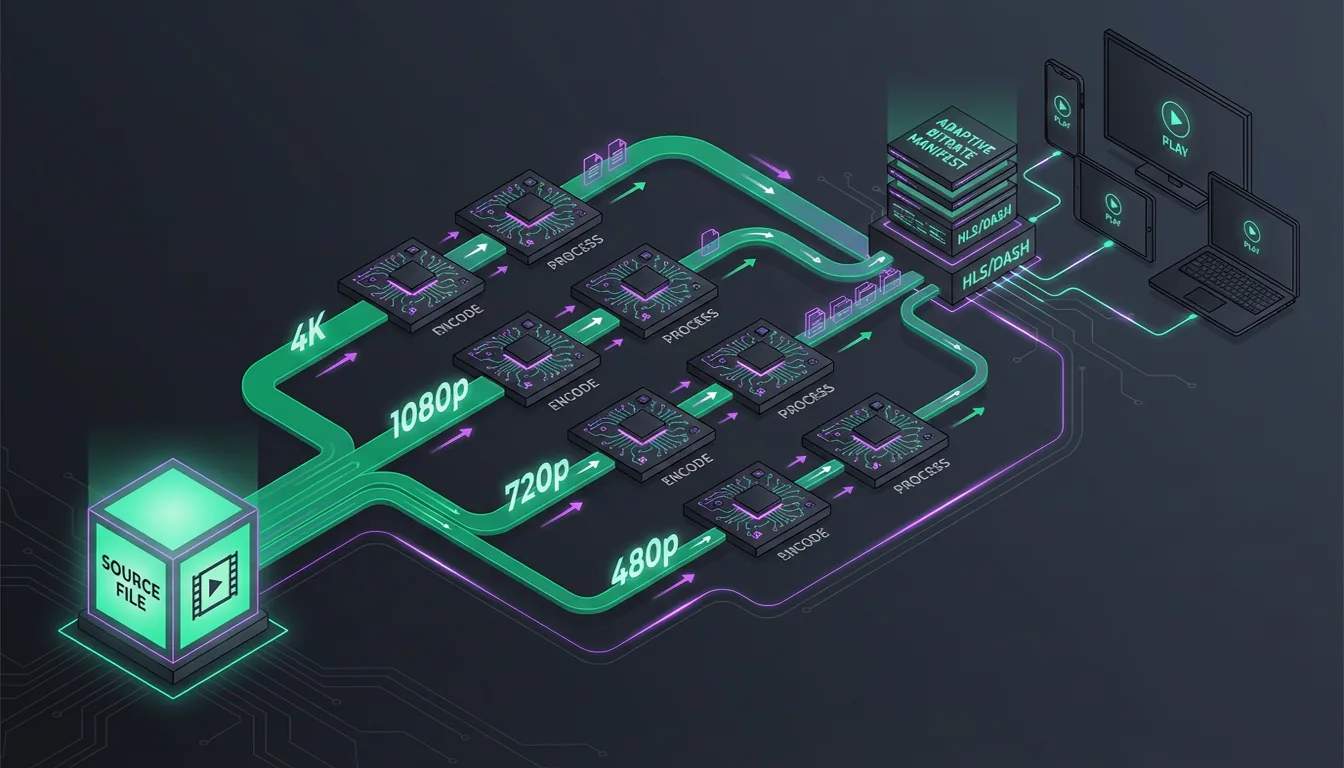
A step-by-step guide to building an HLS adaptive streaming pipeline — from encoding multi-bitrate variants to CDN delivery.
AV1 now powers 30% of Netflix and 75% of YouTube. Here's the current state of adoption, hardware support, and what it means for your video pipeline.
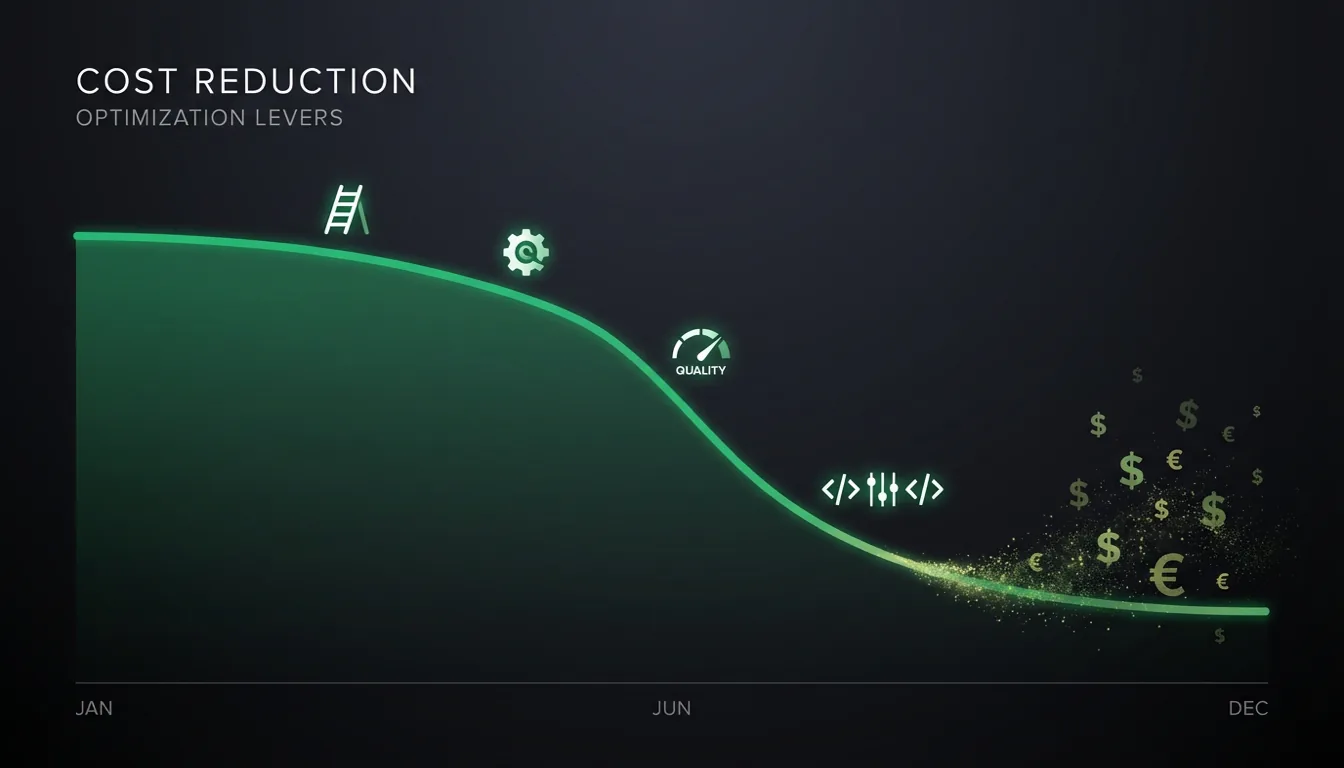
Encoding is only 10-20% of total video cost. Here are 6 practical strategies to cut your overall video bill by up to 60%.
CMAF lets you encode video once and serve both HLS and DASH from the same segments — cutting storage costs and encoding time in half.